Table of Contents
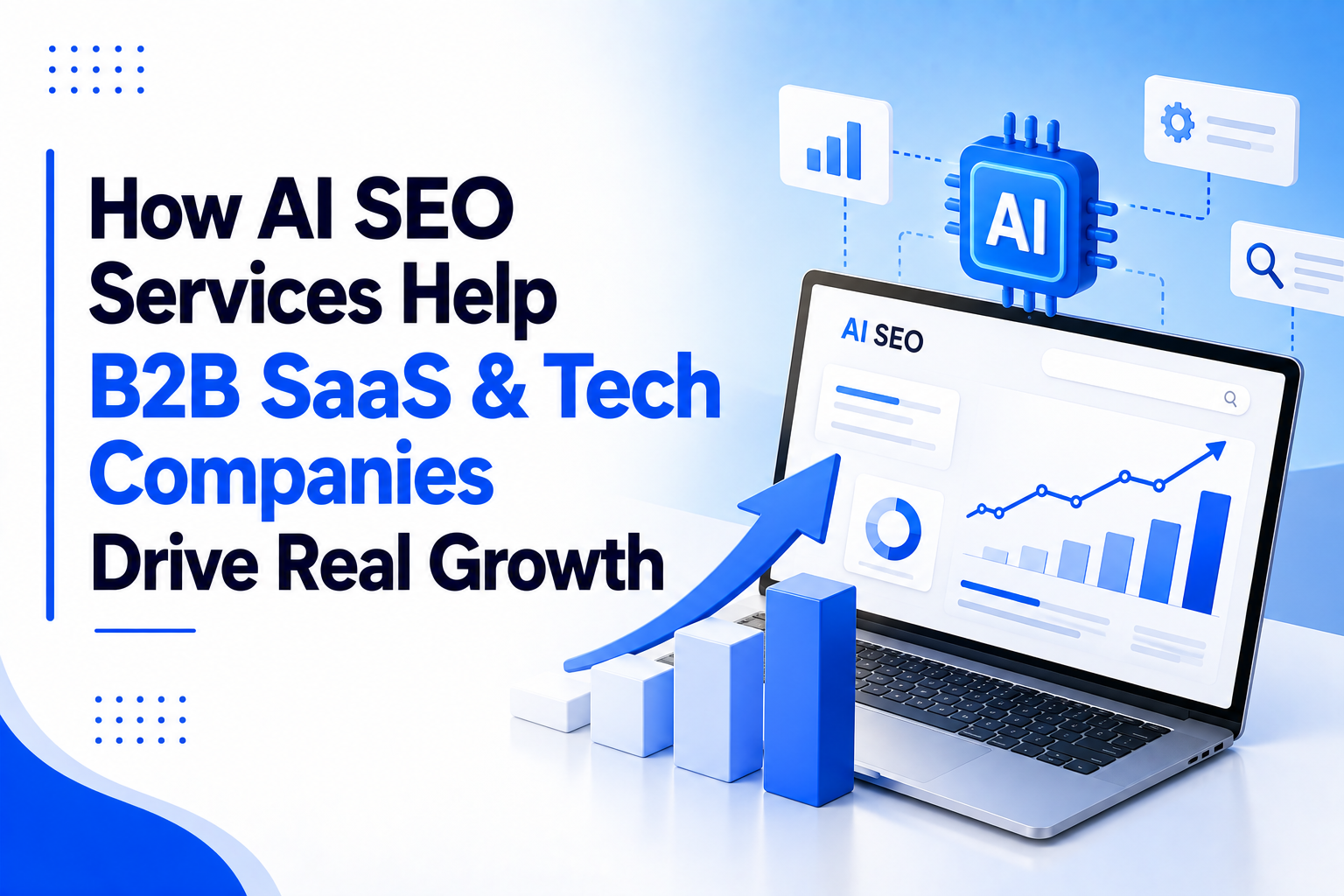
B2B SaaS and technology companies face a very different SEO challenge from most businesses. Your buyers are researching complex solutions, comparing multiple platforms, checking integrations, evaluating alternatives, and involving several decision-makers — long before they ever request a demo.
At the same time, search itself is changing. Potential customers are no longer discovering software only through traditional Google results. They are using AI-powered search experiences, conversational search tools, AI-generated answers, comparison queries, and highly specific problem-focused searches to guide their buying research.
This is where AI SEO services for B2B SaaS companies become a strategic growth lever rather than a background marketing function. Explore the full range of digital marketing services from Ads Planet to understand how AI SEO fits into a broader growth strategy.
What Is AI SEO for B2B SaaS Companies?
AI SEO for B2B SaaS is an approach to search optimisation that combines traditional SEO fundamentals with strategies designed for AI-powered and conversational search experiences. It focuses on making a SaaS company’s website easier for search engines and AI systems to understand, retrieve, summarise, and reference when potential customers research relevant problems, products, and solutions.
AI SEO: What It Adds Beyond Traditional SEO
Traditional SEO remains important. Technical health, keyword strategy, quality content, backlinks, and page experience all still matter. AI SEO expands on these fundamentals by adding Answer Engine Optimisation (AEO), Generative Engine Optimisation (GEO), semantic content strategy, entity optimisation, intent mapping, and AI-assisted competitive analysis — making your brand discoverable across every surface where B2B buyers now research.
For SaaS brands, the broader objective is not to rank for a small list of keywords. It is to become a trusted source around the problems, categories, workflows, integrations, and buying questions associated with your product — across every stage of the B2B buying journey and every search surface where prospects look.
Why Traditional SaaS SEO Alone Is No Longer Enough
Traditional SEO often focuses heavily on broad category keywords. A SaaS company might target phrases like “project management software,” “CRM platform,” or “marketing automation software.” Those keywords can be valuable — but modern B2B search behaviour is far more complex and specific.
A potential buyer is far more likely to search for:
- “Best CRM for a 20-person B2B sales team” — revealing their company size and workflow context
- “HubSpot alternatives for small B2B teams” — actively comparing your product against specific competitors
- “How to reduce customer churn in SaaS” — researching the problem your product solves
- “Software to automate invoice reconciliation” — searching for a solution to a specific pain point
- “How to integrate CRM data with ERP” — evaluating technical compatibility
These searches reveal specific business problems and buying intent that broad keyword targeting entirely misses. AI-powered search environments make intent-matching even more important — users can now ask detailed, conversational questions rather than relying on short keyword phrases, and AI systems summarise answers from the most authoritative, well-structured sources they find.
SaaS companies that optimise only for broad category keywords attract significant traffic with limited pipeline impact. The opportunity is in the specific, problem-focused, comparison, and integration searches that signal actual buying intent.
— Ads Planet Digital Agency
10 Ways AI SEO Drives Real Growth for B2B SaaS & Tech Companies
Reaching High-Intent Buyers Instead of Just Traffic
Not all website traffic has equal business value. A SaaS company could attract thousands of visitors from broad informational keywords without generating meaningful pipeline. AI SEO focuses strategy on the queries closest to actual buying decisions — the searches that indicate a prospect is actively evaluating solutions.
- Best [software category] for [specific industry or company size]
- [Competitor name] alternatives and comparison searches
- [Software A] vs [Software B] evaluation queries
- [Product category] pricing and ROI calculation searches
- Software for [very specific business problem]
Mapping Content to the Full SaaS Buyer Journey
A B2B buyer rarely lands on a website and immediately books a demo. The research journey spans multiple stages — and your brand needs to appear at each one. AI SEO maps content creation to every phase of how buyers discover, evaluate, and ultimately choose a SaaS solution.
Problem Awareness
Searching for information about a business challenge.
Solution Discovery
Researching possible methods or technology to solve it.
Category Evaluation
Comparing different solutions within the category.
Vendor Comparison
Evaluating specific platforms head-to-head.
Decision & Purchase
Searching for pricing, implementation, demos, and case studies.
Building Topical Authority Around Your SaaS Category
Search visibility is not only about individual pages. Search engines also evaluate what your overall website specialises in. A strong AI SEO strategy creates connected clusters of content around the product’s core category rather than isolated, disconnected blog posts.
A menu-costing SaaS platform, for example, might develop content around recipe costing, ingredient cost management, menu pricing strategy, food cost percentage benchmarks, overhead allocation, labour costing, and menu profitability analysis. These topics reinforce one another — and they signal to both traditional search engines and AI systems that this brand has genuine depth in its field.
Answer Engine Optimisation (AEO) for Real Customer Questions
AEO focuses on structuring content so direct answers can be easily understood and retrieved by search technologies — including Google AI Overviews, featured snippets, and conversational AI tools. For B2B SaaS companies, this means answering highly specific buyer questions with clarity and precision before expanding into supporting context.
This answer-first format makes content highly useful across AI-generated summaries, featured snippets, voice search, and conversational search interfaces — multiplying where your brand appears beyond traditional blue-link results.
Generative Engine Optimisation (GEO) for AI-Powered Discovery
GEO focuses on helping SaaS content become understandable, authoritative, and useful within AI-generated search experiences. The goal is not to trick AI systems — it is to create content that is clear, accurate, well-structured, specific, contextually rich, and consistent across the entire website.
A SaaS company’s GEO strategy should ensure AI systems can clearly identify: what the platform does, who it is designed for, what problems it solves, what industries it serves, how it differs from alternatives, what integrations it supports, and how pricing and implementation work. Scattered or vague positioning makes it difficult for both search engines and AI platforms to confidently reference your brand.
AI-Assisted Competitor and Content-Gap Research
B2B SaaS markets can contain hundreds or thousands of relevant search opportunities. Manual research alone makes it difficult to identify them efficiently. AI-assisted SEO workflows help marketers analyse competitor content, keyword clusters, missing topics, search intent patterns, frequently asked questions, and internal linking opportunities at a scale that would take months to replicate manually.
AI Supports Strategy — It Does Not Replace It
A tool may surface a keyword opportunity. An experienced strategist still needs to determine whether it matches the product, whether the audience is relevant, whether it has commercial potential, and where it fits in the buyer journey.
Turning Product Features Into Search Opportunities
Many SaaS websites describe features from the company’s internal perspective — “Advanced workflow automation,” “Smart reporting dashboard,” “AI-powered analytics.” Potential customers often do not search using those exact phrases. They search for the underlying problem that feature solves.
Instead of optimising only for “automated reporting platform,” an effective AI SEO strategy identifies and targets searches like “how to automate weekly sales reports,” “how to reduce manual reporting time,” and “software for automated sales reporting.” Each important feature can potentially support a feature page, use-case page, industry page, comparison page, and supporting blog cluster — significantly expanding organic search coverage.
Bottom-of-Funnel SEO Content That Converts
Many SaaS companies invest heavily in educational blog content but neglect pages closer to actual purchasing decisions. Bottom-of-funnel content — where visitors are already evaluating whether to buy — is where the most commercially valuable organic traffic converts into demos, trials, and pipeline.
- Alternative pages — “[Competitor] alternatives”
- Comparison pages — “[Product A] vs [Product B]”
- Use-case and industry-specific landing pages
- Integration pages for key software connections
- Pricing guides and ROI-focused content
- Implementation guides and onboarding resources
Connecting SEO Content With Lead Generation Paths
SEO should not end when someone reaches the website. Different content types serve different visitor intents — and each requires a specific, relevant conversion path to be most effective. Mismatching content intent with conversion offers is one of the most common ways SaaS companies lose qualified visitors who arrived with genuine buying interest.
- Educational top-of-funnel articles → Related guide, template, or newsletter
- Commercial comparison articles → Product page, case study, or demo request
- High-intent product pages → Free trial, book a demo, or request pricing
- Integration or feature pages → Relevant demo or technical documentation
Strategic Internal Linking Across the SaaS Site Architecture
Internal linking is particularly important for SaaS websites because they contain many different types of pages — product pages, feature pages, industry pages, solutions, integrations, comparisons, resources, blogs, and pricing pages. Strategic internal linking helps users navigate between these resources while helping search engines understand how topics relate to one another.
A blog about reducing customer churn, for example, should logically link to customer analytics features, relevant integrations, retention tools, a churn calculator, and a product demo page. Internal links should provide a genuine next step for the reader — not simply exist for SEO purposes.
AI SEO vs Traditional SEO for SaaS
Traditional SEO and AI SEO should not be treated as competing strategies. AI SEO is better understood as an evolution of modern search optimisation — building on the same technical, content, and authority foundations while extending them to cover how buyers now discover and evaluate SaaS solutions.
| Factor | Traditional SEO | AI SEO for SaaS |
|---|---|---|
| Research Focus | Keyword-focused research | Intent and topic-focused research |
| Discovery Target | Google rankings only | Search + AI-powered discovery surfaces |
| Content Structure | Individual optimised pages | Topic and entity ecosystems |
| Primary Goal | Traffic volume growth | Qualified organic demand generation |
| Content Format | Standard informational content | Answer-focused, structured content |
| Analysis Method | Manual research processes | AI-assisted research and analysis |
| Optimisation Scope | Search engine optimisation | SEO + AEO + GEO |
| Authority Building | Ranking individual keywords | Building SaaS category authority |
What a Complete AI SEO Strategy Should Include for SaaS
A comprehensive AI SEO strategy for a B2B SaaS or tech company covers several interconnected areas — each reinforcing the others. No single component delivers meaningful results in isolation.
⚙️ Technical SEO
- Site architecture and crawlability
- Indexation and canonical management
- Page speed and Core Web Vitals
- Structured data markup
- Duplicate content management
🔍 Keyword & Intent Research
- Category and feature keywords
- Pain-point and problem searches
- Comparison and alternative queries
- Integration and pricing searches
- Full buyer-journey mapping
📄 Content Clusters
- Topical depth around product areas
- Connected supporting blog content
- Industry and use-case pages
- AEO-structured FAQ content
- Internal linking architecture
🏷️ Product Page Optimisation
- Feature-to-problem alignment
- Integration and compatibility pages
- Bottom-of-funnel comparison pages
- Clear conversion paths per page
- Structured data for product entities
🤖 AEO & GEO
- Answer-first content structure
- Clear entity and context signals
- Consistent product positioning
- AI-readable structured information
- Conversational query optimisation
🔗 Authority Building
- Credible backlinks and digital PR
- Expert content and bylines
- Industry partnerships and references
- Conversion-optimised landing pages
- Organic lead-generation strategy
How to Measure AI SEO Success for SaaS Companies
SEO performance for a B2B SaaS company should not be measured using keyword rankings alone. Rankings are a leading indicator — but the metrics that matter most to SaaS growth connect search visibility directly to business outcomes.
Organic qualified traffic (by intent segment)
Non-branded search visibility growth
Product and feature page organic traffic
Demo requests from organic search
Free trial signups via organic channel
Organic-assisted and influenced conversions
Pipeline value attributed to organic search
Visibility for commercial-intent SaaS queries
Conversion rate by organic landing page type
Growth of topic cluster coverage over time
Traffic Is Useful — Qualified Traffic That Becomes Pipeline Is Better
The ultimate measure of AI SEO success for a SaaS company is whether it is contributing to demo requests, free trials, and revenue pipeline — not just session counts. Build your reporting framework around business outcomes from the start, not as an afterthought.
Common AI SEO Mistakes SaaS Companies Should Avoid
Publishing AI-Generated Content at Scale Without Strategy
Generating hundreds of articles does not automatically create authority. Poorly researched, repetitive, or generic content dilutes a SaaS website’s quality signals and can actively harm rather than help rankings in Google’s Helpful Content environment.
Targeting Keywords That Do Not Match the Product
High search volume does not equal high business value. SEO opportunities should align with the specific problems your software actually solves — otherwise traffic arrives without any intent to buy your particular product.
Ignoring Bottom-of-Funnel Searches Entirely
Comparison, alternative, feature, integration, and use-case searches often carry stronger commercial intent than educational content. SaaS companies that invest only in top-of-funnel blogs frequently build traffic without meaningful pipeline.
Creating Separate Pages for Every Minor Keyword Variation
Modern SEO should focus on topics and user intent rather than creating near-identical pages for small keyword variations. Thin page proliferation dilutes crawl budget and signals low quality across the entire domain.
Treating AI SEO as a Shortcut to Avoid Real Work
AI can accelerate research, analysis, clustering, and content workflows. It cannot replace product expertise, original insights, strategy, brand positioning, or quality control. The SaaS companies that gain the most from AI SEO combine technology with genuine subject-matter depth.
How Long Does AI SEO Take to Generate Results for SaaS Companies?
AI SEO is a long-term growth strategy rather than an instant acquisition channel. The timeline depends on factors including website authority, competition level, technical health, existing content, backlink profile, product category maturity, and publishing consistency.
- Newer SaaS websites need time to build topical authority and domain trust
- Established companies may find faster wins by improving existing pages
- Technical SEO fixes can produce ranking improvements within weeks
- New content typically takes 2 to 4 months to rank competitively
- Bottom-of-funnel pages often rank faster than broad educational content
- Consistent publishing compounds authority — momentum builds over months
- Competitive categories require longer timelines than niche verticals
- AEO optimisation for existing content can improve AI visibility quickly
Monitor Progress — Not Just a Fixed Timeframe
Rather than measuring only against a fixed deadline, SaaS companies should track whether qualified traffic, demo conversions, topical keyword coverage, and organic pipeline contribution are improving consistently month over month. Compounding improvements are the signal that strategy is working.
Build Your AI SEO Growth Strategy With Ads Planet
Ads Planet Digital Agency helps B2B SaaS and technology companies build digital strategies focused on stronger search visibility, qualified enquiries, and sustainable organic growth. Our approach goes beyond basic keyword rankings — combining traditional SEO principles with AI-focused search strategies to improve how brands are discovered across both traditional search engines and emerging AI-powered search experiences.
Learn more about Ads Planet and our approach, or explore our complete range of digital marketing services.
Ready to Turn Search Visibility Into SaaS Growth?
If your SaaS or technology company is attracting traffic but struggling to convert visibility into qualified demos and pipeline, your SEO strategy may need to go deeper than rankings. Request a free consultation today.
Request a Free Consultation →Frequently Asked Questions
Ads Planet Digital Agency helps B2B SaaS and technology companies build structured AI SEO strategies — combining traditional search optimisation with AEO, GEO, and intent-based content to improve visibility, attract qualified buyers, and convert organic traffic into demos and pipeline.